Jump to Section
- What music and movement therapy is
- How music builds language and communication skills
- Rhythm and movement for motor development
- Music therapy benefits for adults with DD
- What this looks like at First Step Inc
- Common questions about music and development
- Getting started with First Step Inc
Parents tend to catch it first. Maybe their child starts clapping before anyone says to, or goes quiet the second a song they know comes on. That kind of responsiveness isn’t random. It points to something a trained therapist can actually work with. Music and movement therapy builds on it deliberately, using rhythm, song, and structured movement to reach goals the family and care team have already mapped out together. Some sessions zero in on a single skill, like teaching a child to wait for their turn. Others spend the whole hour on the physical side of things, like developing the hand strength and control it takes to grip a crayon.
What Is Music and Movement Therapy?
Music and movement therapy is a clinical discipline. A trained therapist designs each session around a specific individual and specific goals, using rhythm, song, and structured movement as the tools. What it is not: music instruction. The point is never to teach someone to sing or play an instrument. The point is to use music as a medium to reach developmental, communicative, or physical outcomes that can be genuinely hard to get at any other way.
According to the American Music Therapy Association’s 2021 fact sheet, music therapy is recognized as a related service in special education under IDEA, the Individuals with Disabilities Education Act. That means eligible students can receive it as part of their Individualized Education Program, alongside speech, occupational, and physical therapy.
Adults with developmental disabilities work with music and movement too, not just children. At First Step Inc, that might look like an adult practicing the sequence of steps needed to button a shirt, using a steady beat to anchor the motion. Or a person learning to read facial expressions through call-and-response singing with a therapist. The goals are different at 35 than they are at 8. The tools often aren’t.
How Music Supports Language and Communication Development
Most parents catch it before any therapist brings it up: their child sings a word they can’t say out loud on its own. That’s not a coincidence. It’s the brain doing something real.
Repetition does a lot of the work. When a child hears the same melody again and again, the rhythm starts carrying the words along with it: syllable sequences, articulation patterns, the shape of a phrase all get bundled up with the tune. That’s why a child who goes completely blank trying to recall a word in conversation can sometimes produce it cleanly the moment it shows up inside a familiar song. Singing and speaking actually pull from overlapping but distinct neural networks. So when the speech pathway hits a wall, the musical pathway can still get through. For children with language delays, that means more than one road leads to the same place.
Music therapy also builds the foundational skills that sit underneath all communication, the ones that have to come together before words can do their work:
- Eye contact and shared attention develop when a child and therapist are both focused on the same song, instrument, or movement. There is a natural pull toward each other that direct instruction rarely replicates as easily.
- Turn-taking in music (waiting for the chorus, trading call-and-response phrases) mirrors conversational rhythm in a way that feels like play rather than a lesson
- Rhythm and repetition help children sequence sounds and words, reinforcing the motor patterns that articulation requires. Some children need those patterns practiced dozens of times before they stick.
- A 2024 NIH meta-analysis that reviewed 18 randomized controlled trials involving 1,457 children found music therapy significantly improves language communication outcomes in children with developmental disabilities
Families often describe it the same way the research does: music takes the pressure off. A child who tenses up during direct speech tasks will often engage freely with a song. The repetition is built in. The stakes feel low. And that combination, low pressure paired with high repetition, turns out to be exactly what language learning needs.
For families working on supporting communication development in children with speech and language challenges, music therapy is one of the most well-documented tools in the field.
That same responsiveness to rhythm does not stop at communication. The body tracks a beat too, and that creates a separate set of possibilities for physical development.
Building Motor Skills Through Rhythm and Movement
When someone with a coordination challenge tries to move on their own internal timing, that timing is often unreliable. The body knows what it wants to do, but the signal is inconsistent. A steady beat changes that. It gives the brain something external to lock onto, and the body follows. A drum pattern, a clap, a song with a strong pulse. Something that keeps going whether or not the body cooperates. Movement that felt effortful and fragmented starts to come out smoother, more on time.
Therapists call this rhythmic auditory stimulation. The approach uses a predictable rhythm to time and organize movement, and the results show up across a wide range of people. Children working on early motor milestones use it. Adults with developmental disabilities managing mobility challenges use it. The mechanism is the same: an external rhythm gives the brain something concrete to synchronize with.
Specific activities that build motor function in practice:
- Clapping rhythms and hand percussion build fine motor control, finger isolation, and bilateral coordination through repetitive, structured movement
- Marching to music targets gross motor skills including stride length, balance, and rhythmic weight transfer
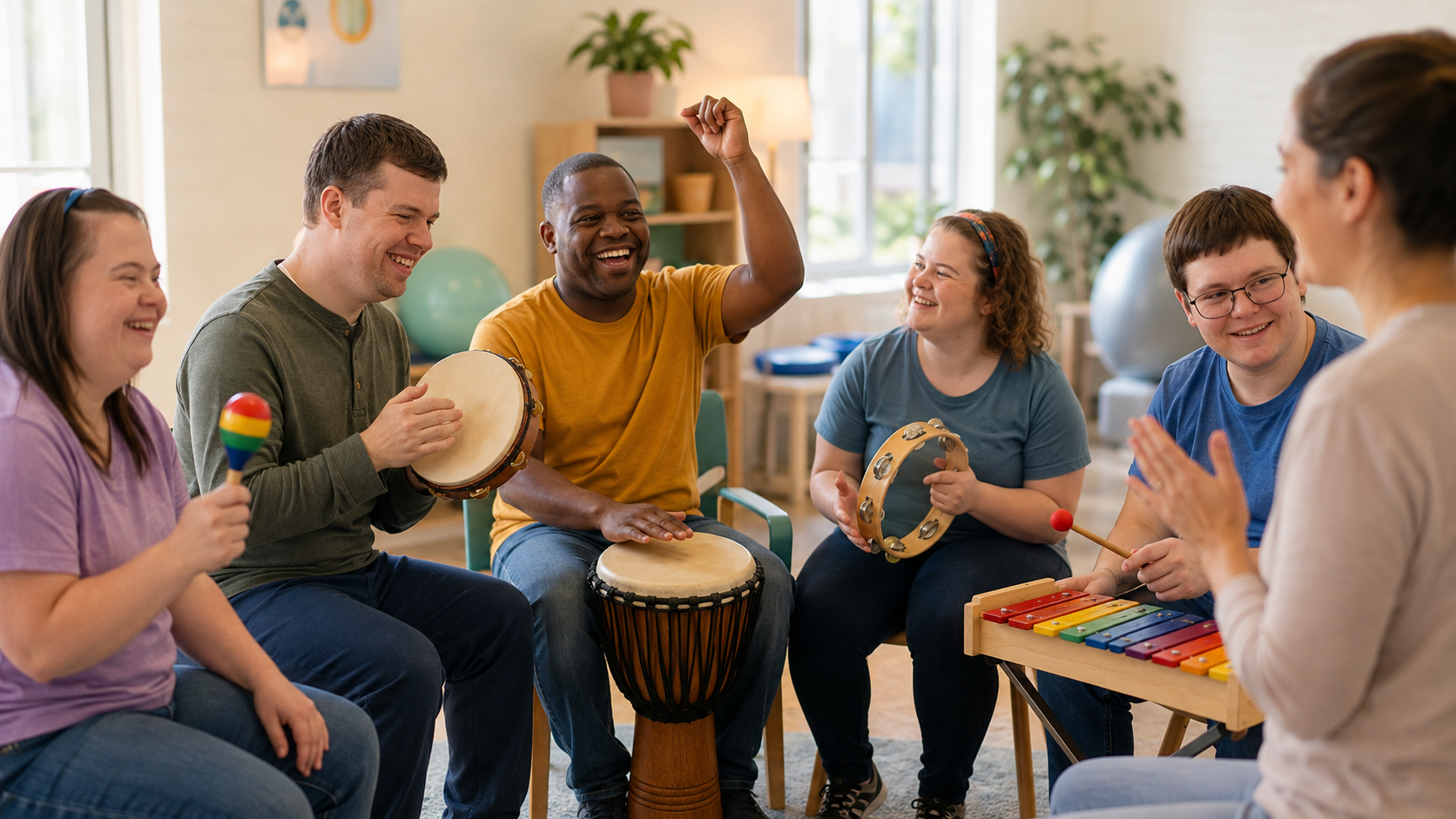
- Playing simple percussion instruments (shakers, drums, xylophones) develops grip strength, wrist control, and hand-eye coordination in an engaging context
- Songs with motions (reach, stomp, clap, sway) layer sequencing and body awareness into activities that feel like play rather than exercise
A 2022 review in Frontiers in Neurology found that neurologic music therapy produces measurable improvements in both gross and fine motor function, supporting its use across the lifespan.
The children’s programs at First Step Inc weave movement-based activities into structured therapy, giving kids a way to build motor skills that doesn’t feel like work. Adults benefit from these same principles, though the goals shift as people grow and their needs change.
Music and Movement for Adults with Developmental Disabilities
Adults show up to music and movement programming for a lot of different reasons. Some are working on mobility. Some are working through anxiety or frustration. Some just want to be in the room with other people and have something to do together. What they find is that a familiar song or a repeated movement sequence is more stabilizing than it might look from the outside. The structure is real. The rhythm is predictable. And over time, that predictability builds something: maintained motor function, steadier emotional regulation, and genuine connection with other people in the room.
In group settings, music does something that other activities often cannot. When a room of adults moves together, passes a rhythm back and forth, or sings a chorus at the same time, that is participation, communication, and shared attention happening in real time. At First Step Inc, the Adult Developmental Day Treatment (ADDT) program builds structured activity programming, including music and movement, into each day alongside other skill-building work. Whether you are an adult living with developmental disabilities or a family member thinking through your options, adult day programs at First Step Inc are designed around your goals, your pace, and your interests, not a generic program calendar.
What Music and Movement Look Like at First Step Inc
At First Step Inc, music and movement are part of the regular day, not a special event. Activities are built around what each person is actually working toward.
For Children: Music and Movement in the EIDT Preschool
In Early Intervention Day Treatment (EIDT) programming, music and movement show up throughout the day in ways that directly support therapy goals. Songs build vocabulary and reinforce language patterns. Rhythm-based games develop coordination and body awareness. Movement activities are paired intentionally with speech and occupational therapy targets so children are practicing skills in a context that feels engaging rather than clinical. Families looking at developmental preschool support will find that these activities are not add-ons to the day; they are built into how learning happens.
For Adults: Music and Movement in ADDT Programming
In ADDT, structured group music and movement activities serve different but equally important purposes. Rhythm-based motor exercises support physical maintenance and coordination. Familiar songs engage memory and cognitive function in ways that feel purposeful rather than therapeutic. Group formats create natural opportunities for turn-taking and social communication. As with children’s programming, we do not believe in one-size-fits-all. Each adult’s music and movement goals are built around what that person actually wants to work on, and the research on early intervention outcomes for children reflects the same principle that has always guided First Step Inc’s work: the sooner and more consistently structured, individualized programming is in place, the more meaningful the gains across a lifetime.
Questions About Music, Movement, and Development
Is music therapy the same as music lessons?
When a child works with a music therapist at First Step Inc, the session might look like play. They might tap a drum to match a rhythm, or sing a short phrase to practice a word they’ve been working on for months. That’s not a music lesson. Music therapy is goal-directed work led by a board-certified music therapist, built around the specific developmental or therapeutic goals of each person. Music lessons develop performance skills around the music itself. Therapy is built around the person.
What age can a child start music and movement activities?
Infants respond to rhythm before they can speak or walk. For children with developmental delays, structured music and movement programming through services like EIDT preschool can begin as soon as a need is identified. There is no minimum age for rhythm-based learning. Early exposure through consistent, supportive programming gives young children an on-ramp to skills that build over time.
Does music therapy support all types of developmental disabilities?
Think about a child with cerebral palsy who lights up when a familiar rhythm starts, and uses that rhythm to coordinate a reaching movement she couldn’t quite get to in other settings. That’s one example of what music and movement can do. Research shows meaningful benefits across a wide range of developmental disabilities, including autism, Down syndrome, cerebral palsy, and speech and language delays, but the reasons why it works are different for each person. Music pulls on several brain systems at the same time, which creates room for learning that other therapies may not open in the same way. A teenager building social engagement is working toward something entirely different than an adult practicing speech clarity, and a well-designed music and movement approach will look different for each of them.
How do I know if music and movement activities are right for my child or family member?
A lot of families come to us with a version of the same question: “I’ve heard music can help, but I don’t know if it makes sense for our situation.”
Honestly? That’s the right starting point.
We don’t need a formal referral or a folder full of evaluations. We just need to know what your child or family member is working on right now. Speech, coordination, being in a room with other people without shutting down. Whatever it is, we talk through it with you and figure out whether music and movement activities would actually move that needle. Sometimes the answer is yes. Sometimes we point you somewhere else. But you won’t leave the conversation without a real answer. A call works. So does stopping by.
How First Step Inc Can Help
Families across Arkansas have found that the right support, introduced at the right time, opens doors they didn’t know were there. First Step Inc serves children and adults with developmental disabilities from our base in Hot Springs, with county offices across the state, so the path to getting started is shorter than many families expect.
If you’re turning that question over and want to talk it through, we’re here for it. Contact your local First Step Inc office and let’s figure out what’s possible together.