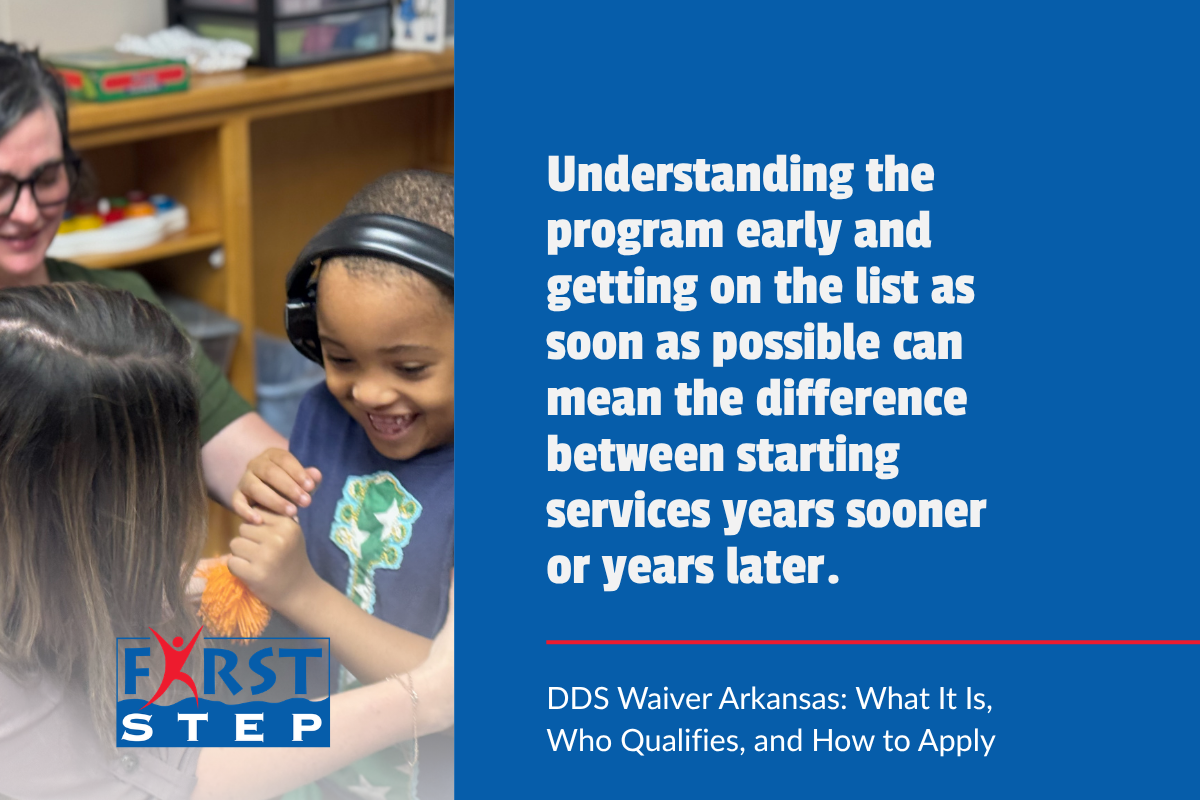
The DDS Waiver Arkansas is a Medicaid-funded program to pay for home and community-based supports for people with developmental disabilities. Administered by Arkansas’s Division of Developmental Disabilities Services (DDS), it supports families and individuals by allowing them to receive care and services in their own homes and communities rather than in institutional settings. Getting a waiver slot takes time, and wait times can extend to 10 years. Understanding the program early and getting on the list as soon as possible can mean the difference between starting services years sooner or years later.
Key Takeaways
Nobody sits you down and explains this stuff. You hear “waiver” at an IEP meeting, or a specialist drops it into conversation like you already know what it means, and then the appointment’s over and you’re in the parking lot Googling. The families who figure out what the DDS Waiver actually covers (and when to apply) aren’t better connected. They just got the information sooner.
What Is the DDS Waiver in Arkansas?
The DDS Waiver exists because nursing facilities and institutional care are expensive, isolating, and (for most people) not what anyone actually wants. It funds the supports that let someone with a developmental disability live at home, work, be part of their community. That’s the whole program, stripped down.
What it pays for varies by person. Personal care, supported employment, day services, residential supports: the mix gets built around the individual. There’s no standard package handed to everyone.
Officially, it’s called the Community and Employment Support (CES) Waiver. It’s a Home and Community-Based Services (HCBS) program, funded through Medicaid and administered by the Arkansas Department of Human Services (DHS). You can find the official program details on the Arkansas DHS CES Waiver page. And if you’re trying to figure out how the CES Waiver fits alongside other Medicaid programs, our guide to understanding different types of Medicaid waivers lays that out clearly.
Once you understand what the waiver covers, the natural next question is whether your family member qualifies to receive it.
Who Qualifies for the DDS Waiver in Arkansas?
The 22nd birthday is the line. Everything hinges on it. If the developmental disability started before age 22, the DDS Waiver becomes a real possibility. Miss that cutoff and the door closes. For those who qualify on age, there are two more hurdles: Medicaid income requirements and a level-of-care standard that confirms the need for this level of support. Here’s what that looks like in practice:
Qualifying criteria include:
- A developmental disability with onset before age 22
- A qualifying diagnosis: intellectual disability, cerebral palsy, epilepsy, autism, Down syndrome, spina bifida, or a related condition
- Meeting the ICF/ID (Intermediate Care Facility for Individuals with Intellectual Disabilities) level of care standard
- Medicaid eligibility (required at the time a waiver slot is offered, not at the time of application)
That ICF/ID standard trips a lot of families up, but it’s simpler than it sounds. It’s not a score on a form. It’s a picture of someone’s daily life. Does your loved one need reminders to shower? Help getting dressed? Someone to walk through a morning routine, step by step, every single morning? Do everyday hazards, a hot stove, an unfamiliar person at the door, not register the way they would for most people? If any of that sounds familiar, your loved one will very likely qualify. The standard is built around exactly that kind of consistent, hands-on support.
Here’s something worth knowing about Medicaid: you don’t need it to get on the waiting list. You can apply now and establish Medicaid later, when a slot actually opens up. Don’t let that piece hold you back from starting.
For a full walkthrough of eligibility and documentation, see how to apply for a waiver and qualify. Once you know you qualify, the natural next question is what the waiver actually pays for.
What Services Does the CES Waiver Cover?
Most families aren’t short on options. They’re short on options that actually work for their person. That’s the gap CES Waiver was built for. And because it runs through Medicaid, there’s no bill at the end of the month: no copays, no surprise costs, nothing owed. What it covers is the part worth paying attention to:
Seven core areas, all of them practical:
- Supported living: hands-on help with daily tasks at home, so a person can live as independently as they choose (learn more about independent living for adults with disabilities)
- Supported employment: job coaching, placement, and ongoing support to help someone land meaningful work and actually keep it
- Community participation support: assistance getting involved in social activities and community life beyond the front door
- Non-medical transportation: rides to work, appointments, and whatever community activities matter to that person
- Specialized medical supplies: items prescribed to support health and daily function
- Adaptive equipment: tools and devices that make independence more achievable
- Person-centered service planning: a plan built around what the individual actually wants from life, not a one-size-fits-all package handed down from a binder
That last point is worth sitting with. These aren’t services delivered according to a checklist. They flex. A job coach, for example, doesn’t just help someone find a position and disappear. They show up to that specific job, learn that role alongside the person, help them figure out coworkers and workplace expectations, and stay involved long enough to make sure things are genuinely going well.
That kind of support changes outcomes. And it starts with the application process.
How to Apply for the DDS Waiver in Arkansas
Pick up the phone. That’s it. That’s the whole first step. One call to DDS gets you into the system, and from there they walk you through everything else. The mountain looks different once you’ve made that call.
- Call DDS Intake and Referral: Reach them at 501-683-5687, or submit a referral request online through the DHS website.
- An Intake Specialist is assigned to your family: They’ll walk you through what documentation you need and explain what comes next.
- Clinical review: The DDS team reviews medical records to understand the level of care your family member needs.
- Submit disability documentation: This includes records confirming a developmental disability that began before age 22: things like psychological evaluations, school IEPs, or academic transcripts.
- Receive an approval letter and waitlist placement: This confirms clinical eligibility and officially places your family member on the waiting list.
- When a slot opens: Your family member is assigned to a PASSE (Provider-Led Arkansas Shared Savings Entity) and can then choose a service provider.
Here’s something a lot of families don’t find out until they’re already in the middle of it: approval and actually receiving services are not the same thing. Getting that approval letter means your family member is clinically eligible. That matters. But it doesn’t mean a slot is waiting for them. Services begin when one becomes available, and depending on the program, that wait can stretch.
So apply now. Even if the timeline feels far off. Even if services feel abstract right now. The earlier your family member is on that list, the closer to the front you’ll be when things open up.
For more detail on each step, visit the waiver application process steps. The Arkansas DHS DDS FAQ also covers common eligibility and documentation questions.
How Long Is the CES Waiver Waitlist in Arkansas?
Up to 10 years. That is the honest answer.
Right now, around 1,900 people are waiting for CES Waiver services in Arkansas. That number used to be much worse; in 2020, it was closer to 4,500. The Arkansas Governor made a real commitment to chip away at this, launching an initiative to serve every waitlisted individual. The progress is genuine. But the wait is still substantial, and families deserve to know that going in.
Here is something almost nobody explains up front: getting approved is not the same as getting services.
When you receive an approval letter, it means your loved one is clinically eligible for the CES Waiver. That matters. But it does not mean a slot just opened up. Services do not actually begin until there is an opening and your application date comes up in line. Those two things can be years apart.
This catches families completely off guard. They get that letter, feel relief, and then wait. And wait. Knowing this distinction now means you will not be blindsided later.
Apply now. Not when things get worse, not after the next evaluation. The waitlist runs by application date: your spot is locked in the day you submit, and every month you wait is a month you’re behind someone who applied before you. It’s a hard reality of the program. While your application is pending, there are other supports worth looking into, and the next section covers those.
What Can Families Do While They Wait?
Waiting for a CES Waiver slot does not mean waiting to get help. Depending on your family member’s age and situation, there are real supports available right now: programs with schedules, staff, and structure that can make a genuine difference while your name moves up the list.
For children: Early Intervention Day Treatment (EIDT) is a licensed, clinic-based program; no waiver required. Your child can enroll now and start receiving evaluations, therapeutic services, and developmental support on a regular schedule. For families watching a young child struggle, EIDT is often what keeps development moving forward instead of stalling out during a years-long wait.
For adults: Adult Developmental Day Treatment (ADDT) is built around the same idea. Adults with developmental disabilities attend on a structured weekly schedule, working on practical skills, receiving assessments, and accessing supervised living supports. It is an active environment with real programming, not a holding pattern. Enrollment does not depend on having a waiver slot.
Health coverage: The DDS waiver covers a lot, but it is not the only path to care. Depending on your family member’s situation, traditional Medicaid, ARKids First, or TEFRA may cover health services in the meantime. It is worth checking eligibility now rather than waiting to see what the waiver eventually brings.
Protect your application date: This one matters more than most families realize. DDS sends an annual letter asking you to confirm your contact information. If you miss it even once, and your name comes off the list. Your application date resets. That can mean years of progress, gone. Watch for that letter every year and respond without fail.
Start planning now: You do not have to wait for a slot to open before you start getting ready. Organizations like First Step Arkansas work with families right now, connecting you with current resources, answering questions about what’s ahead, and helping you build a plan so you are ready when services become available.
For a fuller picture of how these programs work together, the essential guide to Home and Community-Based Services waiver programs is a good place to start.
The wait is real. But the time between now and a waiver slot does not have to be empty. First Step Arkansas can help you use it.
How First Step Arkansas Can Help You Navigate the DDS Waiver
First Step Arkansas is a licensed CES Waiver provider, and that matters because navigating this process alone is genuinely hard. The paperwork assumes you already know the language: eligibility categories, level-of-care assessments, support intensity scales. Nobody hands you a glossary. You figure it out by asking the right person at the right moment, if you’re lucky enough to find them.
The staff at First Step have worked through those forms with hundreds of families. Not just the initial application, but the annual reviews too, the ones that arrive every year with new requirements layered onto requirements you thought were already settled. They’ve seen what trips families up, and they know how to build a service plan around what your loved one actually needs, not just what’s easiest to check off a form.
Two years on a waiting list with nothing to show for it but vague updates and unanswered calls? That’s a real conversation First Step has had with families. So is the one where someone walks in and says they haven’t even started yet, they don’t know where to begin. Both of those are fine. That’s what they’re here for. You don’t need to have it figured out first.
Learn more about CES Waiver Services at First Step, or reach out to us directly at 501-624-6468.
Frequently Asked Questions
What is the DDS waiver in Arkansas?
Arkansas’s DDS runs several Medicaid-funded waiver programs, and the big one is the CES Waiver (Community and Employment Support). The whole point of it is to help people with developmental disabilities live and work in their communities, not in institutions.
How do I apply for the DDS waiver in Arkansas?
Call DDS Intake and Referral at 501-683-5687 and they’ll get the ball rolling. You’ll be assigned a specialist, go through a clinical review, and complete the paperwork to secure your spot on the waitlist. It sounds like a lot, but they walk you through each step.
How long is the CES Waiver waitlist in Arkansas?
Honest answer: it’s long. Around 1,900 people are waiting right now, which is actually a big improvement from roughly 4,500 in 2020, but wait times can still stretch up to 10 years. Your place in line is locked in by your application date, so early really does matter here.
What services does the CES Waiver cover?
Real coverage. Supported living, supported employment, community participation, transportation, adaptive equipment, person-centered planning. Everything built around keeping someone in their community, not parked somewhere waiting for life to happen.
Can my child apply for the DDS waiver?
Absolutely, and you don’t have to wait until things feel like a crisis. The CES Waiver is open to Arkansans of any age with a qualifying developmental disability. Since your position on the waitlist is tied to when you applied, getting that application in now is one of the best things you can do for your family’s future.
Start Your DDS Waiver Application in Arkansas Today
The waitlist is long. That part is true, and it’s worth saying plainly. But your place on it starts the day you call, and that day can be today.
The DDS waiver is one of the most meaningful resources available to Arkansans with developmental disabilities. Getting there takes time. It also takes someone in your corner who knows the process and will stay with you through it.
First Step Arkansas does both. Contact our team or learn more about our CES Waiver services to take the first step.
First Step, Inc.
Looking for support for someone you love?
We serve children and adults with developmental disabilities across Hot Springs, Malvern, Fordyce and Glenwood. Tell us what you need and our team will walk you through the options, including the CES Waiver.